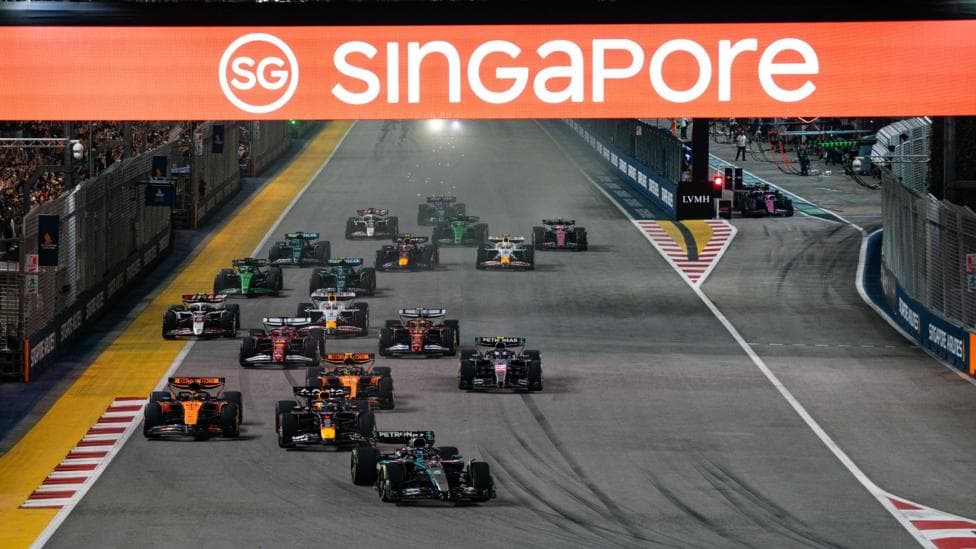
F1 heat hazard declared for fourth time this season
October 8, 2026
Formula 1’s Singapore Grand Prix has been officially designated as a heat-hazard race, marking the fourth time this season the classification has been applied. The status, introduced in 2025, allows teams to equip drivers with cooling vests and liquid-pumping systems to counteract temperatures expected to exceed 31°C during the event.
Singapore’s tropical climate—consistently hovering between 31°C and 33°C with high humidity—has long posed extreme physical demands on drivers, as seen in 2024 when Mercedes’ George Russell and Lewis Hamilton required treatment for heat exhaustion after the race. Even at night, when the race is held, temperatures remain near 30°C, compounding the challenge for competitors.
While cooling systems are optional, drivers opting out must carry an additional 5 kg of ballast to offset any advantage. The technology, which circulates cooled glycol through a fireproof vest, faces practical hurdles: maintaining liquid temperature for the race’s full duration—especially in Singapore, the longest event of the year—proves difficult, and some drivers find the vest uncomfortable in tight cockpits.
Mercedes has chosen not to use the system, citing insufficient budget under the FIA’s $50,000 allowance for developing a reliable setup. Deputy team principal Bradley Lord called the funding ‘insufficient’ to create a solution robust enough for the entire race, prioritizing performance gains instead.
This year’s heat-hazard races now include Austria, Italy, Bahrain, and Singapore, underscoring the growing frequency of extreme conditions in modern F1.
 Afghanistan
 Bangladesh
 South Africa
 Australia
 Pakistan
 Sri Lanka
 India
India West Indies
 Manchester United FC
 Tottenham Hotspur FC
 Liverpool FC
 Manchester City FC
 Hyderabad Kingsmen Academy
 Sui Northern Gas Pipelines Limited
 Khan Research Laboratories
 State Bank of Pakistan
 Oil & Gas Development Company Limited
 Ghani
Ghani Pakistan Television
 Victoria
 South Australia
 New York Yankees
 Tampa Bay Rays
 Chicago White Sox
 Cleveland Guardians
 Dallas Cowboys
 Tampa Bay Buccaneers